


Your central vision plays a vital role in terms of allowing you to read a book, recognize familiar faces, and drive safely. However, age-related macular degeneration (AMD) affecting the macula, can create issues in seeing these fine details. An eye specialist in Siliguri or any other place can help detect these kinds of problems.
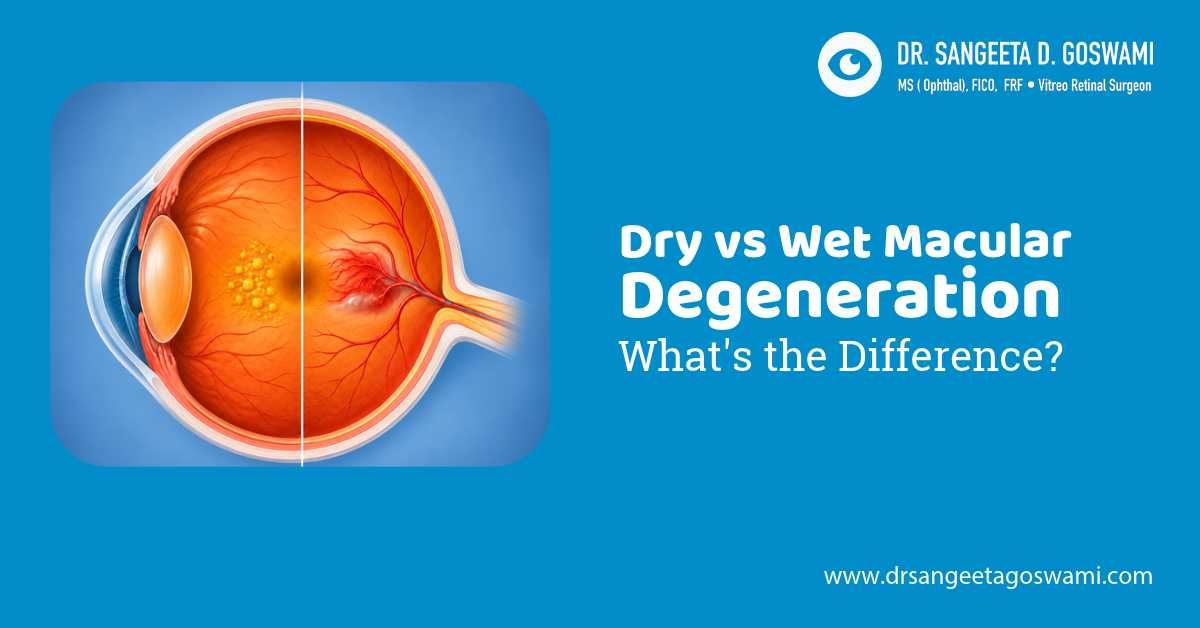
AMD occurs in two main forms, which are dry (non-neovascular) and wet (neovascular) macular degeneration. Both these conditions affect central vision, but the main difference lies in how they develop and progress. Dry AMD usually develops slowly, while wet AMD can cause faster vision changes due to abnormal blood vessels growing beneath the retina.
Understanding Dry vs Wet Macular Degeneration can help you recognise their symptoms, causes, and treatment options. Regular eye examinations and timely medical advice are important for managing changes in your vision.
What Is the Macula and Why Is It Important?
The macula is a small part of the retina that helps you see clearly and focus on fine details.
Macula important
It helps you with everyday activities such as:
- Reading: Seeing letters and words clearly.
- Recognising faces: Identifying familiar people.
- Driving: Seeing road signs and objects ahead.
- Seeing details: Noticing small objects.
- Identifying colours: Distinguishing different colours.
Macular Degeneration
Macular degeneration is an eye condition that damages the macula. It can cause blurred or distorted central vision, making everyday activities difficult. Peripheral (side) vision usually remains unaffected.
Differences between Dry and Wet Macular Degeneration
|
Factors |
Dry Macular Degeneration |
Wet Macular Degeneration |
|
Medical name |
Non-neovascular AMD |
Neovascular AMD |
|
Occurrence |
More common |
Less common |
|
Main changes |
Drusen buildup and macular thinning |
Abnormal blood vessel growth |
|
Blood vessel leakage |
No abnormal leakage |
Blood vessels may leak fluid or blood |
|
Progression |
Usually slow |
Often faster |
|
Onset |
Generally gradual |
Can be sudden |
|
Early symptoms |
May have no noticeable symptoms |
May cause noticeable vision changes |
|
Vision changes |
Gradual central blurring |
Rapid central vision changes |
|
Visual distortion |
Usually develops in advanced stages |
Straight lines may appear wavy |
|
Dark spots |
May occur in advanced stages |
Dark or blank spots may appear centrally |
|
Reading difficulty |
Develops gradually |
May develop more quickly |
|
Risk factors |
Age, genetics and smoking |
Age, genetics, smoking and existing AMD |
|
Diagnosis |
Retinal examination and OCT |
Retinal examination, OCT and sometimes angiography |
|
Treatment |
Monitoring, lifestyle changes and supplements for eligible patients |
Anti-VEGF injections and selected other treatments |
|
Progression risk |
May develop into wet AMD |
Already an advanced form of AMD |
|
Vision loss |
Can cause significant central vision loss |
Can cause rapid and severe central vision loss |
What Causes Dry and Wet Macular Degeneration?
Causes of Dry Macular Degeneration
Dry AMD develops when macular cells break down, and drusen (small yellow deposits) build up beneath the retina. Risk factors include:
- Age: Risk increases after 50.
- Family history: A close relative with AMD may increase your risk.
- Smoking: Raises the risk of macular degeneration.
- Genetics: Certain inherited genes increase susceptibility.
- High blood pressure: May increase the risk of AMD.
Causes of Wet Macular Degeneration
Wet AMD occurs when abnormal blood vessels grow under the retina and leak fluid or blood.
Risk factors include:
- Age: Risk increases with age.
- Dry AMD: It can develop into wet AMD in some people.
- Family history: Having a close relative with AMD may increase your risk.
- Smoking: Increases the risk of AMD.
- Genetics: Certain inherited genes may increase susceptibility.
What Are the Common Symptoms of Dry and Wet Macular Degeneration?
Symptoms of Dry Macular Degeneration
- Central vision may become blurry as the condition progresses.
- Small letters and printed words may become harder to read.
- You may need brighter light for reading or close-up tasks.
- Recognising familiar faces may become difficult.
- Adjusting to low-light conditions may take longer.
- Dark or blank patches may appear in central vision in advanced stages.
Symptoms of Wet Macular Degeneration
- Straight lines may appear wavy or bent.
- Central vision may become blurry over a short period.
- Reading may become difficult due to distorted or missing letters.
- Familiar faces may look unclear or distorted.
- Objects may appear smaller or larger than they actually are.
- Sudden changes in central vision may occur.

How Does Dry Macular Degeneration Progress Compared to Wet AMD?
Progression of Dry Macular Degeneration
Dry AMD develops in three stages:
- Early: Small or medium-sized drusen form beneath the retina. Symptoms are usually absent.
- Intermediate: Drusen grows larger, and vision may become blurry.
- Advanced: Retinal cells break down, causing central vision loss.
Progression of Wet Macular Degeneration
Wet AMD can progress quickly:
- Blood vessel growth: Abnormal vessels form beneath the retina.
- Vision changes: Blurred vision and wavy lines may appear.
- Scarring: Damage may lead to permanent central vision loss.
Dry AMD can develop into wet AMD, but this does not happen to everyone. Regular eye check-ups help detect changes.
How Are Dry and Wet Macular Degeneration Diagnosed?
An ophthalmologist examines your eyes and may recommend these tests to check for AMD:
Dilated Eye Examination
- Eye drops widen your pupils.
- The doctor checks your retina and macula.
Optical Coherence Tomography (OCT)
- Takes detailed images of the retina.
- Shows thinning, fluid buildup, and other changes.
Fluorescein Angiography
- A dye is injected into a vein in your arm.
- Images show abnormal blood vessels and leakage.
Amsler Grid Test
- Check for wavy or missing lines on a grid.
- The doctor checks for wavy or missing lines.
Visual Acuity Test
- You read letters on an eye chart.
- Measures how clearly you can see.
Most tests help assess both types of AMD. Doctors mainly use fluorescein angiography to check for abnormal blood vessels and fluid leakage in wet AMD.
What Are the Treatment Options for Dry and Wet Macular Degeneration?
The treatment depends on the type of AMD and the extent of damage to the macula. After examining your eyes, the ophthalmologist can explain which options may be suitable.
Treatment Options for Dry Macular Degeneration
- AREDS2 supplements: May slow progression in people with intermediate AMD or certain cases of advanced AMD.
- Regular eye check-ups: Help track changes in the retina.
- Healthy diet: Include leafy green vegetables, fruits, and fish in your meals.
- Quitting smoking: Stopping smoking may reduce the risk of further progression.
- Low-vision aids: Magnifying glasses and reading devices can help with everyday activities.
- Geographic atrophy treatment: Certain injections may slow the growth of damaged areas in eligible patients.
Treatment Options for Wet Macular Degeneration
- Anti-VEGF injections: Help reduce abnormal blood vessel growth and fluid leakage in the eye.
- Photodynamic therapy (PDT): Uses a light-sensitive medicine and laser treatment to target abnormal blood vessels. It is used in selected cases.
- Regular monitoring: Follow-up visits and OCT scans help the doctor check how the condition responds to treatment.
When Should You Visit an Eye Specialist?
Changes in your central vision can affect reading, driving and recognising faces. If you notice any of the following problems, arrange an eye examination.
Symptoms That Need an Eye Examination
- Blurred central vision that does not go away.
- Difficulty reading or recognising familiar faces.
- Trouble seeing small objects and fine details.
- Straight lines looking wavy or bent.
- Dark or blank spots in central vision.
Symptoms That Need Urgent Attention
- Sudden changes in central vision.
- New or worsening distortion in your eyesight.
- A sudden dark or blank patch in the centre of your vision.
- Sudden loss of vision in one or both eyes.
Sudden changes in eyesight need prompt medical attention. Contact an ophthalmologist or retina specialist rather than waiting for your next routine check-up.
How Can You Reduce the Risk of Macular Degeneration Getting Worse?
Some daily habits can help protect your eye health and may lower the risk of AMD progression.
- Avoid smoking and tobacco products.
- Eat leafy green vegetables, fruits, and fish.
- Have your eyes checked regularly.
- Keep blood pressure and other health conditions under control.
- Take AREDS2 supplements only if your doctor recommends them.
- Watch for changes in your central vision.
Conclusion
Knowing the difference between Dry vs. Wet Macular Degeneration can help you understand the symptoms and treatment options.
If you notice blurred vision, wavy lines, or dark spots, visit an ophthalmologist for an eye examination. Do not ignore seeking medical advice if you notice sudden changes in your vision.
Remember, regular eye check-ups help monitor AMD and detect changes in the retina. Your doctor can recommend treatment to manage your condition.
Frequently Asked Questions
How Do I Know If My Macular Degeneration Is Wet or Dry?
An eye examination and OCT scan can help identify the type. Dry AMD usually develops slowly, while wet AMD may cause wavy lines, dark spots, or faster changes in vision.
What Is the Treatment for Wet Macular Degeneration?
Anti-VEGF injections are commonly used to treat wet AMD. They help stop abnormal blood vessels from growing and leaking fluid.
Can Wet Macular Degeneration Go Back to Dry?
No. Treatment can control wet AMD, but it does not turn it back into dry AMD.
What Is the Latest Treatment for Wet Macular Degeneration?
Faricimab and high-dose aflibercept are newer anti-VEGF treatment options. Some patients may be able to go longer between injections, depending on how they respond to treatment.
What Helps with Macular Degeneration Naturally?
Eating a balanced diet, exercising regularly, avoiding smoking, and managing blood pressure can support eye health. However, these habits do not cure macular degeneration.